Small Metal, Big Clues: How Fastenings Date a Secondhand Find
You spot a wool jacket in a charity shop in Sheffield. The label has long gone, the colour is lovely, and the price is low enough to make you pause. Before you try it on, turn it over. Look at the buttons. Find the zip. Check the hook at the waistband. Fastenings are not a perfect science, but they are often more honest than a label that may have been removed, replaced or misread.
Start with the buttons
Buttons are the easiest hardware to read because you can feel them. Horn, bone and mother-of-pearl have a weight and warmth that plastic often lacks. Glass buttons catch the light differently. Early plastics such as celluloid, Bakelite and acrylic all have their own tells, though it takes practice. A visible mould seam or a very uniform, lightweight button usually points to later plastic rather than an older natural material.
Turn the button over. Backmarks can be useful: a British maker’s name, a union mark or a stamp such as ‘Made in England’ can suggest a period, though reproductions exist. More telling is consistency. A full set of matching buttons with matching thread suggests the garment has stayed together. One odd button, a mismatched size or a different shade often means a replacement. That is not automatically bad. A replaced button can keep a good coat in use. But if several buttons are mismatched and the buttonholes look strained, the closure has been under pressure.
Look at the buttonholes too. Hand-worked buttonholes, bound buttonholes and careful matching thread are signs of care. A rough, stretched buttonhole at the waist or bust is a wear point. Self-covered buttons can be homemade and charming, but check that the fabric has not shredded underneath.
What a zip can tell you
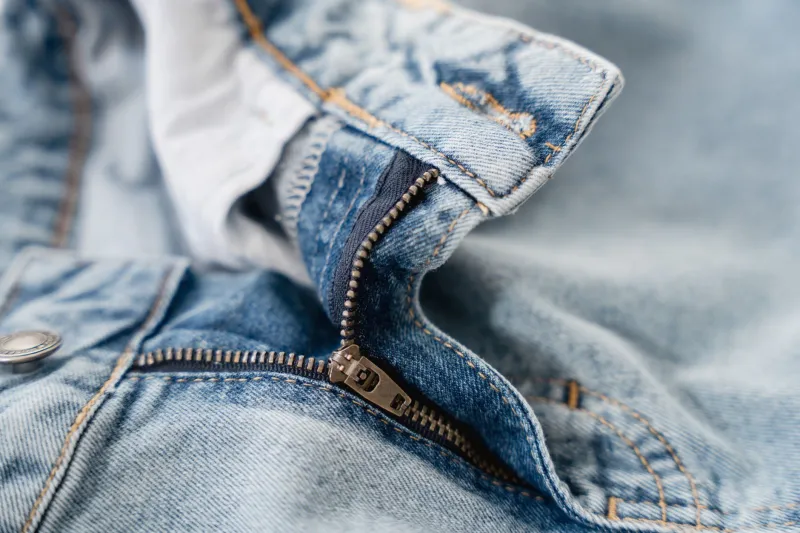
Zips are where dating gets interesting. Metal teeth with a branded pull can suggest an older garment, but not always. Nylon coil zips became common from the mid-twentieth century onwards, and invisible zips moved from specialist dressmaking into mainstream clothing later. A zip marked YKK is not automatically modern; the company has been making zips for decades. Look at the pull shape, the stop box, the tape and the teeth rather than one brand name alone.
A replaced zip is common and not always a dealbreaker. A good wool coat with a cleanly fitted modern zip can still be a excellent buy if the price reflects it. What you want to avoid is a bad replacement. Look for fresh stitching that does not match the rest of the garment, a zip tape that is much stiffer or shinier than the surrounding fabric, or a zip that has been set in slightly crooked. If the lining has been hand-sewn back in a hurry, or the fabric around the zip looks puckered, the repair may have been done at home without the right tools.
Test the zip properly. Run it all the way up and down, slowly. Check that the pull stays on, the teeth mesh and the bottom stop is intact. A zip that splits behind the pull or has missing teeth near the waist is a tailor job, not a five-minute fix. In the UK, replacing a zip can easily cost more than a cheap secondhand garment, so factor that in before you reach the till.
Hooks, eyes and poppers
Hooks and eyes, trouser bars and press studs are small but revealing. Look for corrosion, missing loops and stretched eyes. A waistband hook that has pulled through the fabric once will often do it again unless it is reinforced. Poppers on jackets and children’s wear can be replaced, but they need the right tool and a bit of patience. If the popper has torn away and taken fabric with it, you are looking at a visible repair.
Rouleau loops, bound buttonholes and covered hooks are more work to fix than a simple button. That does not mean walk away, but it should affect what you are willing to pay. A beautiful 1950s dress with one broken covered hook is a manageable project. A winter coat with a torn placket, missing buttons and a split zip is a different proposition.
When wonky fastenings mean walk away
Check the stress points first: the fly, the front placket, the waistband, the cuffs and the shoulder seams. A loose button is easy. A torn buttonhole is not. A missing hook is easy. A ripped waistband where the hook has pulled through is fiddly. A zip with missing teeth at the bottom is usually a replacement job.
Be wary of fastenings that have been disguised. A row of decorative buttons with a hidden press stud behind them can be fine, but check that the hidden closure actually works. A garment with a lovely button front and a broken zip underneath is not a bargain if you cannot wear it. Also look for rust stains around hooks and poppers, especially on lining. Rust marks often mean damp storage, which is worth weighing up alongside any musty smell.
A quick field checklist
- Turn the garment inside out and look at the stitching around the zip.
- Compare the buttons with the fabric: do they look like they have aged together?
- Run the zip fully up and down, and check the bottom stop.
- Fasten every hook, eye and popper before you buy.
- Look for rust, torn buttonholes and stretched plackets.
- Price the repair before you commit. A £4 shirt with a £25 zip replacement is not a £4 shirt.
Fastenings will not tell you everything. They can be replaced, and a canny seller can swap buttons. But they are a useful second opinion when the label is missing and the price is tempting. In a charity shop or at a vintage fair, take thirty seconds with the hardware. It is often the quietest part of a garment, and sometimes the most revealing.