The Rain Tax: Why a Cheap Secondhand Handbag Can Be the Most Expensive Thing You Buy This Winter
Charity shops in November are full of handbags that look like a bargain from three feet away. Leather satchels, mock-croc clutches, little boxy bags with proper clasps. Pick one up and it seems solid enough. Put it down and someone else will. That is the pressure of a good secondhand find.
But a bag is a small piece of engineering asked to survive a British winter. It has to cope with rain on the walk to the station, a damp hallway, a radiator that turns leather brittle, and the weight of everything we insist on carrying. A cheap bag can become an expensive bag once you have paid a cobbler to re-stitch a strap and bought a leather restorer to feed the corners. Call it the rain tax. It is worth calculating before you reach the till.
Start with the strap, not the label
A handbag label tells you who made it. It does not tell you whether the strap anchors are about to give way. Turn the bag upside down and look at where the strap meets the body. Are there little cracks around the rivets? Is the leather stretched into a thin, shiny patch? Has someone reinforced it with a loop of dark thread that does not match the rest of the stitching?
Strap repairs are rarely cheap. A simple re-stitch might be £15 to £25 at a local cobbler, but a strap that has torn out of the bag body can need a leather patch and a new rivet, which quickly pushes the job towards £40 or more. If the bag itself is £18, you are already upside down. That does not make it a bad bag. It makes it a bad buy for that price.
The five-minute shop-floor audit
You do not need a magnifying glass. You need to empty the bag, turn it over and use your hands.
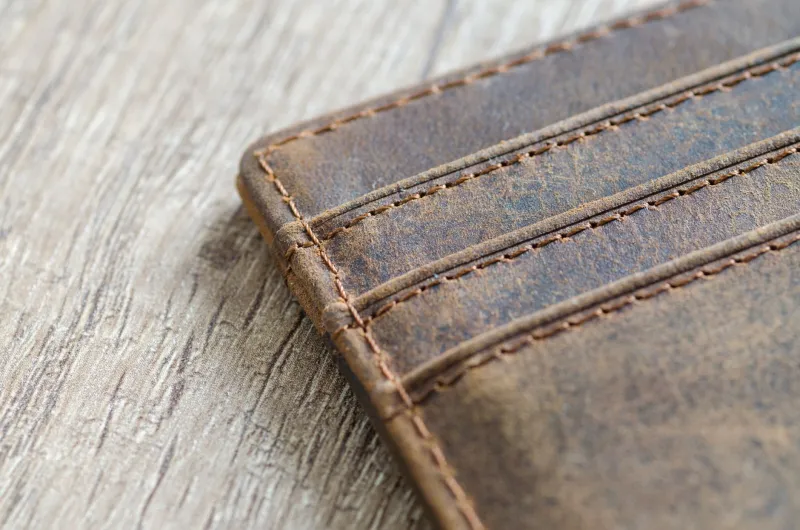
First, check the base corners. These take the most abuse. Rub your thumb along the corners. If the leather feels dry, fuzzy or papery, it is probably past the point of a quick polish. If the colour comes away on your finger, walk away. Dye transfer is one thing; crumbling finish is another.
Second, look inside the lining. A bag can look lovely outside and be a mess within. Shine your phone torch into the corners. Is the lining torn at the seams? Is the fabric around the zip splitting? Is there a sticky residue where a previous owner has tried to glue it? A lining replacement can cost more than the bag is worth, and a loose lining will snag on keys and tissues until you lose patience with it.
Third, check the hardware. Zip teeth should run smoothly without catching. Clasps should snap, not flop. Look at the plating on buckles and rings. If it is flaking off in patches, it will only get worse. Replacing hardware is fiddly, and finding a match for an older bag is often impossible.
Fourth, inspect the interior seams. Turn the bag inside out if you can. Look for loose stitches, glue marks and patches of lining that have been hand-sewn in a hurry. Invisible repairs are not always bad, but they tell you the bag has already had a hard life. A neat repair by a previous owner is fine. A lumpy repair hidden under a flap is a warning.
Finally, smell the bag. Not deeply, just enough to notice damp, mould or heavy perfume. Mustiness in a lining is difficult to shift, especially in a flat with no airing cupboard. If the bag smells like a cellar, assume it has been stored like one.
What rain and radiators actually do
British winters are hard on secondhand leather. Rain soaks into stitching and trapped moisture softens the fibres. Then central heating dries everything out too fast. The result is leather that cracks at stress points, lining fabric that goes brittle and hardware that starts to pit.
That is why a bag that feels lovely in a warm shop can feel stiff and tired by February. It is also why the shop-floor check matters. You are not just buying the bag in front of you. You are buying the version of it that has been rained on twice and left next to a radiator.
The repair maths
Before you buy, do a quick sum. Add the purchase price to the likely repair. A new strap, a re-stitched seam, a zip replacement, a leather feed and a bit of edge paint can easily add £30 to £60. If the total is more than you would pay for a new bag you actually like, the bargain is not a bargain.
There is also the time cost. A bag that needs a cobbler means a trip into town, a wait, and a second trip to collect it. If you are buying it because it is cheap, ask yourself whether you are buying a bag or adopting a project.
The walk-away threshold
Here is a simple rule for a wet British winter: if the bag needs more than one repair to be usable, walk away. One small fix is fine. A strap re-stitch on an otherwise sound bag is a reasonable trade. But cracked corners plus a torn lining plus flaking hardware is not a bargain. It is a donation with a price tag.
The same applies to bags with hidden repairs. If the seller has glued a strap back on, or stitched a patch over a tear with visible thread, treat it as a sign that the bag has already failed once. It can still be loved, but it should be priced accordingly. If it is not, leave it for someone who enjoys a project more than you do.
If you do buy it
Take it home and empty it properly. Wipe the lining with a barely damp cloth and let it dry away from direct heat. Feed leather with a proper conditioner, not hand cream. Stuff it with acid-free tissue or clean paper to hold its shape, and store it somewhere with a bit of airflow. A damp hallway is not a home for a vintage bag.
A good secondhand handbag can last for years. But it has to survive the weather you actually have, not the weather in the shop. Check the strap, the corners, the lining and the hardware first. Pay later only if the maths still works.