Shop By Torchlight: Judging Vintage Finds After the Sun Clocks Off
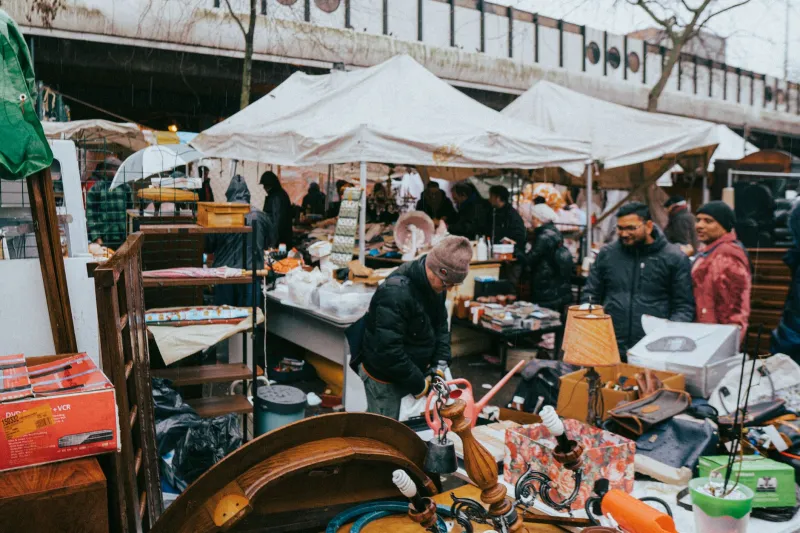
There's a particular kind of optimism that kicks in around 3:40pm in a British charity shop in November. The rails are full, the heating is on, and the strip lights are doing their best impression of daylight. They are not doing a good job. By the time you've taken a dark coat to the till, the sky outside is already that bruised grey-blue, and you're making a colour judgment under conditions that would make a photographer weep.
This isn't a reason to stop shopping between now and spring. It's a reason to shop differently. Winter light is not neutral — it's a co-conspirator. It deepens blacks, merges navy into black, turns brown into black, and politely erases the exact flaws you'd spot in ten seconds on a bright June morning. The fix isn't willpower. It's a small torch, a white tissue and a willingness to stand in a doorway looking slightly odd.
Why the light is lying to you
Fluorescent tubes push blue. That's why the faded black jumper on the rail looks inky and rich, and why it looks like a washed-out charcoal when you get it home. Under warm shop lighting, dark brown and navy both collapse into 'black-ish'. Rust marks on cream read as shadow. Moth nibbles in a dark wool blend simply vanish into the texture. Pilling on a knit looks like a soft halo rather than a problem.
The worst offender is phone flash. It's harsh, it blows out detail, and it makes every fibre look either shiny or flat. If you've ever bought something from an eBay listing shot with flash on a kitchen worktop, you already know.
The pocket kit that costs less than a coffee
You don't need much. A small pocket torch — a keyring one is fine, as long as it isn't the phone flash — a clean white tissue or a receipt, and a doorway or window. The tissue is your true-white reference: hold it next to the garment and the lie falls apart. That 'black' coat with a greenish cast next to white paper? That's not black. That's a dark olive that's been through the wash forty times.
Use the torch at a low, raking angle across the surface rather than shining it straight on. Straight-on light flattens everything. Raking light catches thin patches, small holes, pulled threads and the slight depression where a moth has had a go. Turn the garment inside out and check underarms, cuffs, hems and the seat of trousers. Fading shows up inside seams before it shows on the surface.
The doorway test, step by step
Take the item to the shop door or the nearest window. Ask first if you need to — most volunteers are completely fine with it. Hold the white tissue against the fabric. Compare. Then take a photo by the window with no flash. If you're shopping for someone else, or you're genuinely undecided, that photo is the one you'll look at later when the shop lighting isn't seducing you.
One more thing: if the shop has a doorway, stand in it. Actual daylight — even the weak, grey stuff of a British November — is more honest than any interior lighting ever invented.
What to ask online sellers between now and spring
Online is where winter light does the most damage, because you can't stand in a doorway. Ask for a photo taken by a window, no flash, with a piece of white paper in the frame. Ask for close-ups of underarms, cuffs, collar and hem. Ask for a short video of the item being turned in daylight. A good seller will do it. A seller who won't is telling you something.
Be specific in your questions. 'Is the colour true to life?' is fine, but 'does the black look grey or green next to white paper?' is better. 'Any thinning, nibbles or marks that don't show in the photos?' is fair and not rude. If the listing says 'black' and the photo looks black, ask for the window shot anyway. It's a two-minute favour that saves a return.
What's safe to buy now, and what can wait
Bold colours, patterned tweed, chunky knits and anything with enough contrast to read clearly under a torch are all fine in November. You can see a red coat. You can see a check. You can see a cable knit. The danger zone is the subtle stuff: black formalwear, navy and charcoal tailoring, dark brown leather, pale pieces where a faint stain matters, and anything expensive enough that fading affects what it's worth.
If you're spending proper money on a dark winter coat, wait for a Saturday morning. If you're buying a £4 jumper because you like the shape, buy it and enjoy it. The dark afternoon test isn't about being paranoid. It's about knowing which purchases need daylight and which ones don't.
Winter shopping is slower, and that's not a bad thing. Buy the thing you can actually see. Defer the thing you're imagining. The sun will be back — and so will the same coat, probably, in slightly worse condition and slightly better light.